
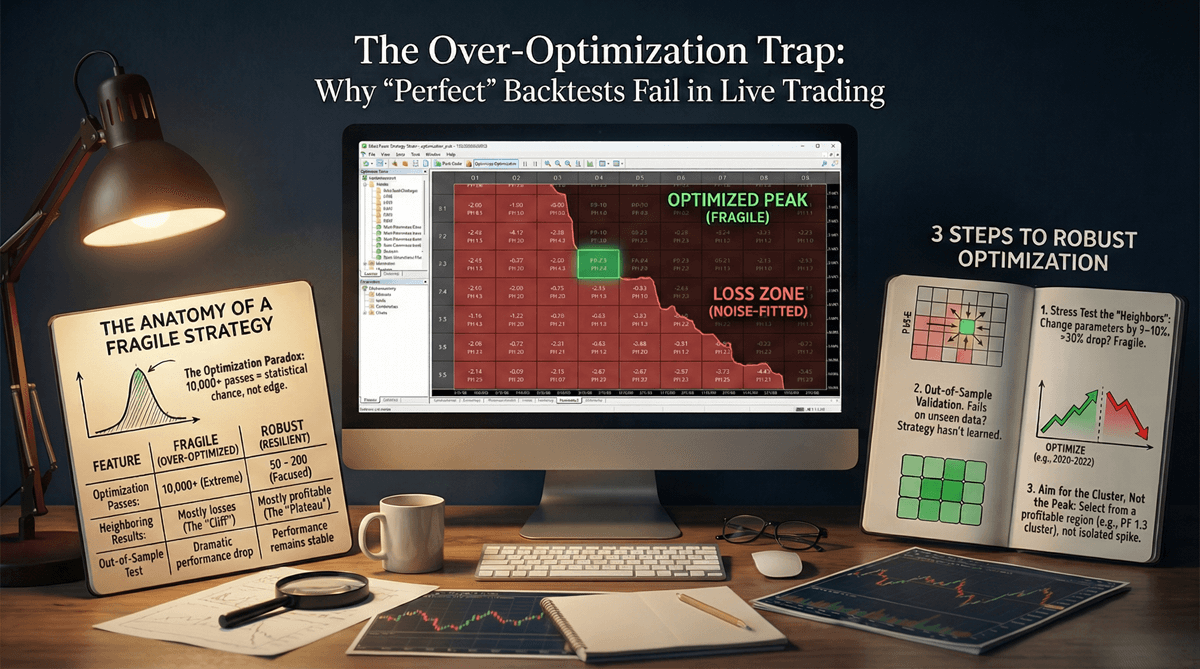
Your EA’s best backtest result is almost certainly its worst live parameter set. Over-optimization follows a predictable pattern, one that an EA consulting project has to rule out first: the trader who spends the most time finding “perfect” settings ends up with the most fragile live performance. Running thousands of Strategy Tester optimization passes does not find the best parameters — it finds parameters that fit historical noise, and they will fail in live trading. The reason is mechanical, predictable, and fixable — but only if you stop trusting the number the optimizer shows you.
The Optimization Instinct (And Why It Feels Right)
MetaTrader’s Strategy Tester makes optimization easy. Select your EA, check the optimization box, define parameter ranges, hit Start. The terminal runs hundreds or thousands of combinations and hands you a sorted list — highest profit factor at the top, complete with a green equity curve. It feels productive. It feels like progress.
The instinct is obvious: more combinations tested means a more thorough search, which means better parameters. If 500 passes found a good set, surely 10,000 will find a better one.
A typical sequence: a trader runs a full optimization on EURUSD — 10,000 passes across 2 years of data, every combination of stop loss, take profit, indicator period, and entry threshold. The top result shows an 83% win rate, 2.4 profit factor, and a smooth equity curve. It looks like a winning system. They go live. Within three weeks, the EA underperforms parameters they could have selected at random.
The green equity curve was not showing a good strategy. It was showing a parameter set that happened to align with past price movements — movements that will not repeat in the same sequence.
What Actually Happens During 10,000 Optimization Passes
Think of it like fitting a curve to data points. If you have 10 data points and a simple straight line, the line might miss some points but it captures the trend. Give the model enough flexibility — a 9th-degree polynomial — and it passes through every point perfectly. It looks like a perfect fit. But it predicts nothing, because it memorized the noise between points instead of learning the signal.
The Strategy Tester optimizer works the same way. An EA with 4 parameters, each tested across 10 values, produces 10,000 combinations. Most of those combinations are garbage — random parameter sets that lose money. But here is the key: with 10,000 combinations tested against 500 trading days, some will match historical price action purely by chance. Not because the parameters capture real market behavior, but because with enough attempts, coincidence is guaranteed.
The optimizer ranks those coincidences at the top of the results list. The trader sees “profit factor 2.4” and believes they found something real. What they actually found is the combination of garbage parameters that happened to look good on that specific price sequence.
This is curve fitting, not optimization. The distinction matters because curve-fitted parameters are not just “slightly worse” in live trading — they are specifically calibrated to a past that will not repeat. They are optimized for noise.
The Two Warning Signs Your EA Is Over-Optimized
Before going live with optimized parameters, run two tests. Both are accessible directly in MetaTrader without external tools.
Test 1: The Parameter Cliff
Take your “best” parameter set and change each value by 5–10% in both directions. Run those neighboring combinations through the Strategy Tester.
If performance drops more than 30% from a 5% parameter change, the result is fragile. You are standing on a cliff, not a plateau. Robust parameters have neighbors that also perform reasonably — maybe slightly worse, but still profitable. Fragile parameters are isolated peaks surrounded by losses. Those peaks exist because the optimizer found a narrow coincidence in historical data, not a stable edge.

Test 2: Out-of-Sample Collapse
Split your data into two periods. Optimize on the first period only — say 2019 through 2022. Then test the optimized parameters on 2023 through 2024 without re-optimizing. Do not touch the parameters. Run them cold on data the optimizer has never seen.
If performance drops dramatically, the parameters memorized the training period. They did not learn a repeatable pattern — they learned the specific sequence of price movements in your optimization window.
Consider an EA optimized on three years of GBPUSD data. The optimized period shows a 2.1 profit factor. The out-of-sample period — just 12 months of subsequent data — shows 0.4. The strategy does not survive contact with unseen price action: a weekend of optimizing has produced parameters worth less than a coin flip on data the optimizer has not seen.
For a deeper look at structural problems hiding inside EAs that appear to work, see Anatomy of a Code Rescue.
What Competent Optimization Actually Looks Like
The fix is not to stop optimizing. It is to optimize less and validate more. Three steps transform curve-fitting into robust parameter selection.
Step 1: Reduce the Parameter Space
Test 50 to 200 combinations, not 10,000. Use fewer parameters with fewer values per parameter. If your EA needs 6 parameters with 20 values each to produce a profit, the trading logic is likely the problem — not the parameter tuning.
Start with the parameters that have the strongest theoretical basis. A stop loss distance based on ATR volatility has a reason to exist. A magic combination of RSI period, MACD signal, and Bollinger deviation that “works on EURUSD H1 between 2020 and 2023” has no reason to generalize.
Step 2: Walk-Forward Testing
Optimize on period 1, test on period 2. Then optimize on periods 1+2, test on period 3. Roll forward and repeat. This forces parameters to prove themselves on data the optimizer has not seen — repeatedly, not just once.
MetaTrader does not automate walk-forward testing natively, but the manual workflow is straightforward: run the optimization, note the parameters, change the date range, run a single backtest with those fixed parameters. Repeat across 3 to 5 segments. If the parameters hold across segments, they are capturing something real.
At barmenteros FX, this is the workflow we apply when clients send us their optimization results for review — strip the parameter space down, walk forward across multiple segments, and find the robust region instead of chasing the peak result.

Step 3: Accept Worse Backtests
The best single result from an optimization is almost always the most over-fit. Instead of selecting the top row, look at the optimization results as a landscape. Find regions where most nearby combinations are profitable — clusters of 1.2 to 1.4 profit factor, not an isolated 2.5 spike.
A parameter set showing 1.3 profit factor surrounded by other profitable neighbors is more reliable in live trading than a parameter set showing 2.5 surrounded by losses. The 1.3 captures a broad, stable edge. The 2.5 captured a narrow historical coincidence.
The Uncomfortable Truth About Your “Best” Settings
The settings you are most confident about — the ones you found after hours of systematic optimization — are statistically the most likely to be noise-fitted. The more time you invested in finding them, the more combinations you tested, and the more opportunities the optimizer had to find coincidences in historical data.
This is not intuitive. Effort should correlate with quality. In optimization, the correlation runs the other way. Traders who pick “good enough” parameters — parameters that pass the cliff test, survive walk-forward validation, and sit in a stable region of the optimization landscape — and move to forward testing on a demo account get better live results than those who chase the perfect backtest.
The goal of optimization is not the best backtest. It is the most resilient parameter region — the set of values where your EA performs consistently across different market conditions, not spectacularly on one specific historical period. Run the cliff test. Run the out-of-sample test. If your parameters survive both, you have something worth risking real money on. If they do not, the optimizer told you what you wanted to hear, not what your account needed to know.
Want an independent evaluation of your optimization results?

Leave a Reply