
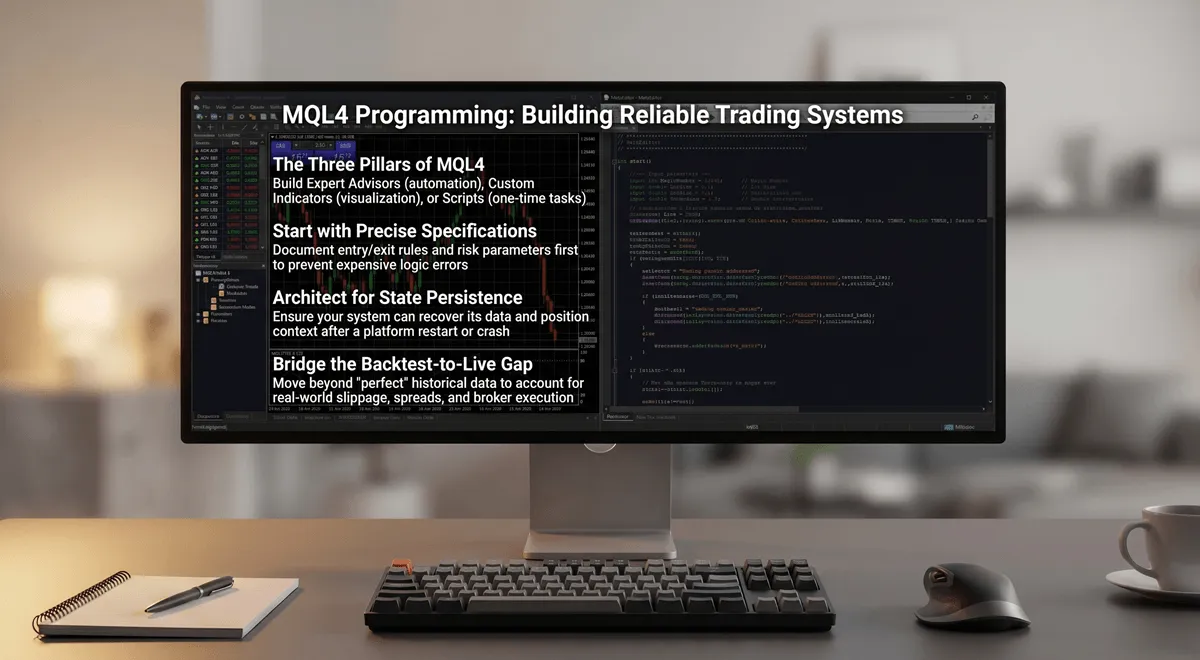
MQL4 programming is the language behind every Expert Advisor, custom indicator, and script running on MetaTrader 4. At barmenteros FX, we have been building MQL4 trading systems since 2011 — from simple crossover EAs to multi-pair basket strategies with state persistence and crash recovery. This guide covers what MQL4 can do, how professional development works, and where most projects go wrong.
If you already have a strategy and need it automated, request a free quote to discuss your project.
What Is MQL4 Programming
MQL4 (MetaQuotes Language 4) is a C-like programming language built specifically for MetaTrader 4. It provides direct access to price data, order management, and technical indicators — everything needed to automate a trading strategy.
Unlike general-purpose languages, MQL4 is purpose-built for trading. The language handles tick-by-tick price feeds, manages open positions through broker servers, and runs inside the MetaTrader 4 terminal. Every trading automation on MT4 — from a simple moving average alert to a complex grid recovery system — runs on MQL4 code.
The official MQL4 Reference documents the language syntax. This article focuses on what happens after you understand the syntax: building systems that survive live trading. For platform fundamentals, see our MetaTrader 4 introduction.
What You Can Build with MQL4
MQL4 supports three types of programs, each serving a distinct purpose:
Expert Advisors (EAs) automate trading decisions. An EA can monitor price action, execute trades, manage positions, and apply risk rules — all without manual intervention. EAs range from simple single-indicator strategies to multi-timeframe systems managing dozens of simultaneous positions.
Custom Indicators calculate and display data on charts. While MT4 includes standard indicators (RSI, MACD, moving averages), custom indicators let you visualize proprietary calculations — zone detection, multi-pair correlation, or session-filtered volatility bands.
Scripts run once and stop. They are useful for batch operations: closing all open orders, calculating position sizes, or exporting trade history. Unlike EAs and indicators, scripts do not respond to new ticks.
In practice, most client projects at barmenteros FX involve EAs — automating a complete strategy from entry logic through position management to exit rules. Learn more about our Expert Advisor programming services.
How MQL4 Development Works
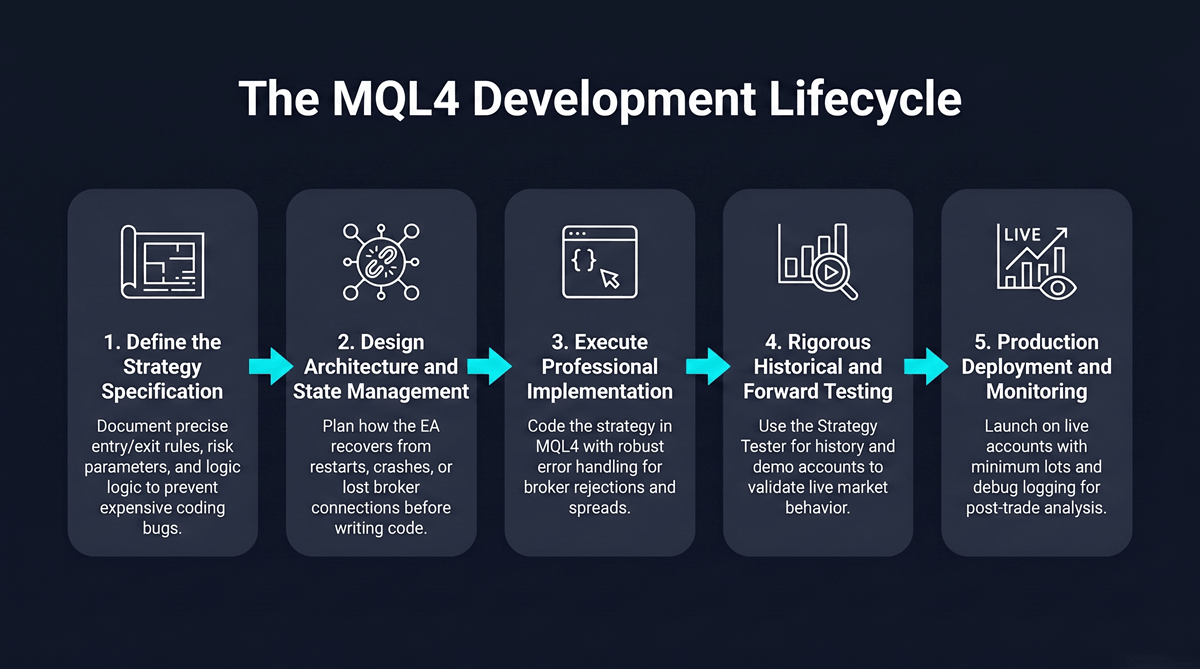
Professional MQL4 development follows a structured process. Skipping steps is how projects end up in rescue mode.
- Strategy specification. The trading logic is documented in precise terms: entry conditions, exit rules, position sizing, risk parameters, and edge cases. A well-written specification prevents the most expensive category of bugs — logic that works as coded but not as intended.
- Architecture and state management. Before writing a single line of trade logic, the developer decides how the EA handles state: What happens when MetaTrader restarts? How are open baskets tracked? Does the EA recover from a lost connection? These architectural decisions determine whether the EA survives production or crashes on the first weekend gap.
- Implementation. The strategy is coded in MQL4, following the specification. This includes order management, error handling for broker rejections, spread filtering, and time-based session controls.
- Testing. The Strategy Tester validates the logic against historical data. Forward testing on a demo account validates behavior under live market conditions — slippage, requotes, and connection drops that backtests cannot simulate.
- Production deployment. The EA runs on a live account, typically starting with minimum lot sizes. Debug logging confirms every decision the EA makes, allowing post-trade analysis.
Where MQL4 Projects Fail
After 14 years of building and rescuing MQL4 systems, the same failure patterns repeat. None of them are about code syntax.
State persistence. MQL4 stores variables in RAM. When MetaTrader restarts — updates, VPS reboots, crashes — every variable resets to its default value. An EA tracking a basket of 8 trades loses its basket context on restart. The fix requires writing state to files or global variables and recovering on initialization. Most EAs skip this entirely.
Backtest-to-live gap. A strategy that shows 80% win rate in the Strategy Tester can lose money live. Backtests use historical data with perfect execution — no slippage, no requotes, no spread widening during news. Live trading introduces all three. The EAs that survive production account for these differences in their logic. See our analysis of over-optimization and why more backtests make your EA worse.
Broker-specific edge cases. Different brokers return different error codes, enforce different stop levels, and handle pending orders differently during news events. An EA hardcoded for one broker’s behavior breaks silently at another. Production-grade code validates broker constraints before every order modification.
Multi-pair and multi-timeframe complexity. An EA that works reliably on EURUSD H1 may fail on GBPJPY M5 — different spread ratios, different volatility profiles, different session characteristics. Read more in why EAs that work on EURUSD break on everything else).
These are the problems we fix most often in code rescue projects — functional code that compiles and backtests well but fails under real market conditions.
MQL4 vs MQL5 — When to Migrate
MQL4 runs on MetaTrader 4. MQL5 runs on MetaTrader 5. They are separate languages with different order management models, different testing capabilities, and different broker ecosystems.

| Factor | MQL4 / MT4 | MQL5 / MT5 |
|---|---|---|
| Order model | Per-order (OrderSend, OrderModify) | Position-based (netting or hedging) |
| Strategy testing | Single-threaded, basic optimization | Multi-threaded, forward testing built-in |
| Broker availability | Declining — many brokers phasing out MT4 | Growing — MetaQuotes actively developing |
| Existing codebase | Large legacy base | Smaller but modern |
When to stay on MQL4: Your broker only offers MT4, your existing EAs work in production, and there is no business reason to migrate.
When to migrate to MQL5: Your broker is discontinuing MT4 support, you need multi-threaded optimization, or you are starting a new project with no legacy code.
Migration is not recompilation. MQL4 and MQL5 handle order management fundamentally differently. A proper migration rewrites the order layer, adapts to the position-based model, and re-validates all trading logic. See our detailed guide on MT4 to MT5 migration.
Hiring a Developer vs Learning Yourself
MQL4 is learnable. The syntax is straightforward for anyone with C/C++ experience, and the MQL4 Reference documents every function. The question is not whether you can learn it — it is whether learning it serves your goal.
Learn MQL4 yourself if: You want to build trading tools as a long-term skill, you have programming experience, and you have months to invest before producing production-ready code.
Hire a developer if: You have a specific strategy ready to automate, you need production reliability (state management, error handling, crash recovery), and your time is better spent on strategy research than debugging broker error codes.
Most clients who reach barmenteros FX have already tried building their own EA or hired a cheap freelancer. The pattern is consistent: the EA works in backtest, fails live, and the client needs a professional rebuild. Browse our MT4 programming services to see how we approach development.
Our Expertise in MQL4 Programming
barmenteros FX has been building MQL4 trading systems since 2011 — over 14 years of continuous client delivery from Marbella, Spain. Our work covers the full range: simple indicator alerts, complex multi-pair EAs with basket management, grid systems with dynamic lot sizing, and full MT4-to-MT5 migrations.
What sets our work apart is production focus. Every EA we deliver includes state persistence (survives restarts), broker-agnostic error handling (works across different brokers), and debug logging (every decision is traceable in the Experts log). These are not premium features — they are the minimum for an EA that runs unattended on a live account.
We also rescue and rebuild EAs that others built — AI-generated code that compiles but crashes live, freelancer projects abandoned mid-development, and legacy systems that stopped working after a broker update. Roughly 40% of our projects are code rescues, not new builds.
Frequently Asked Questions
Is MQL4 programming hard to learn?
MQL4 syntax is accessible to anyone with basic programming experience — it resembles C with trading-specific functions added. The difficulty is not the language itself but the domain knowledge required for production-quality code: handling broker disconnections, managing state across restarts, avoiding backtest overfitting, and testing under realistic market conditions. Learning the syntax takes weeks; learning to build reliable live systems takes years.
What is the difference between MQL4 and MQL5?
MQL4 runs on MetaTrader 4 and uses a per-order trade model — each trade is an independent object. MQL5 runs on MetaTrader 5 and uses a position-based model where trades on the same symbol aggregate into a single position (unless hedging mode is enabled). The languages also differ in their testing engines, event handling, and available standard library functions. They are not interchangeable — migrating code between them requires rewriting the order management layer.
How much does it cost to hire an MQL4 programmer?
Professional MQL4 development at barmenteros FX starts at $200 for simple modifications and typically ranges from $500 to $2,500+ for full EA development, depending on strategy complexity. Factors that drive cost include: number of entry/exit conditions, position management complexity (basket, grid, hedging), state persistence requirements, and multi-pair support. We provide fixed-price quotes after reviewing your strategy specification.
Can AI tools like ChatGPT write MQL4 code?
AI tools can generate MQL4 code that compiles. The code frequently fails in live trading because AI models lack domain knowledge about broker-specific behavior, state management requirements, and the backtest-to-live execution gap. At barmenteros FX, code rescue projects — fixing AI-generated or poorly built EAs — represent a growing share of our work. The code compiles, the backtest looks good, but the EA loses money live because of issues AI cannot anticipate.
Should I learn MQL4 or MQL5?
If you are starting from scratch with no existing codebase, learn MQL5. MetaQuotes is actively developing MT5 while MT4 development has been frozen since 2018. Many brokers are migrating to MT5. However, if you have existing MT4 infrastructure and your broker still supports it, there is no urgency to migrate — MT4 remains functional and widely used. The decision depends on your broker’s platform roadmap, not on which language is “better.”
How long does it take to develop an Expert Advisor?
A simple EA (single indicator, one pair, basic entry/exit) takes 1-2 weeks. A medium-complexity EA (multiple conditions, basket management, session filters) takes 3-6 weeks. Complex systems (multi-pair, grid/martingale with recovery, full state persistence) take 6-12 weeks. These timelines include specification review, development, testing, and revision cycles. The specification phase — agreeing on exactly what the EA should do — often takes as long as the coding.
Next Steps
If you have a trading strategy and need it automated in MQL4, we can help. We provide fixed-price development with clear deliverables — you own the code outright.
Request a Free Quote → — Describe your strategy and we will respond with a detailed scope assessment and price estimate.
If you are evaluating whether to fix an existing EA or build from scratch, read our framework: How We Evaluate Whether to Fix or Rebuild Your EA.
James W.
Good breakdown of EA automation on MT4 – though I’ll say the real challenge isn’t the coding, it’s having the right tool for each market regime. Gold trades completely differently than majors, especially during geopolitical events, and generic EAs get slaughtered on those sentiment spikes. I’ve been testing the gold-specialized bots from Ratio X Toolbox on MT5, particularly their DeepSeek AI version and the ML model built specifically for XAUUSD, and the difference in drawdown management across different volatility phases is night and day. Have you found that backtesting on commodity pairs requires a different stress-testing approach than forex EAs?
barmenteros FX
Great point — and I completely agree.
The main issue with many generic EAs is exactly what you describe: they implicitly assume a stable market regime, while in reality instruments like XAUUSD behave very differently depending on volatility clustering, liquidity shifts, and macro-driven sentiment.
In my experience, the biggest gap is not the strategy logic itself, but how the system adapts (or fails to adapt) to regime changes. This affects not only entries but especially drawdown control and position management.
Regarding backtesting, yes — commodity pairs typically require a different approach. Using a single historical distribution tends to hide regime-dependent risk. I usually treat them as a sequence of distinct volatility environments rather than one continuous dataset.
It would be interesting to hear how you’re segmenting your tests across different phases, especially for gold.
Günter
Hi I need a compiler for a Data Fil in .ex4 into a ql4
barmenteros FX
Hi Günter. Unfortunately we don’t have such a tool. Regards